What wind load actually measures
Wind load combines three inputs: the speed of the air, the area it pushes against, and the shape and surface of that area. Engineers express the first as dynamic pressure, a value that rises with the square of wind speed. Doubling the wind speed does not double the force, it roughly quadruples it. That one relationship explains why a rig that feels solid in a light breeze can become a serious problem in a gust, and why outdoor planning cannot rely on how something feels during load-in.
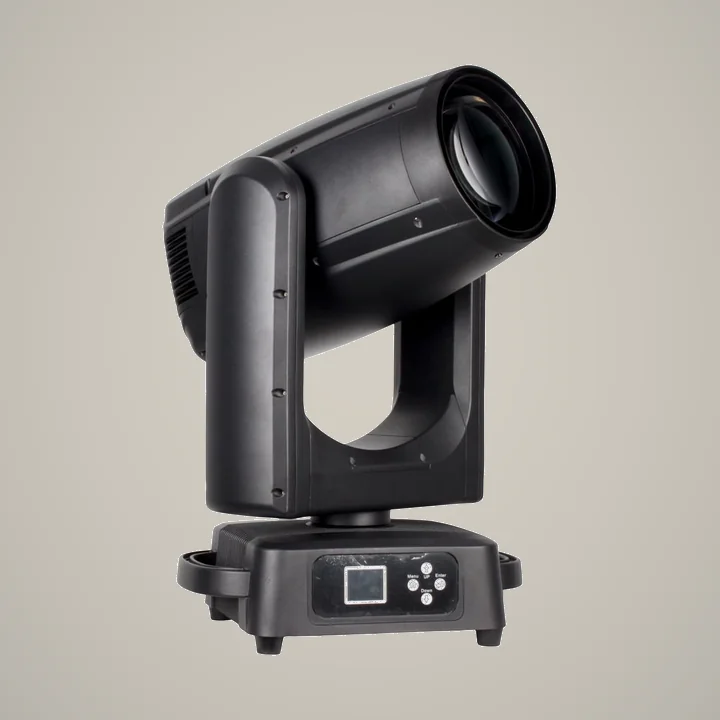
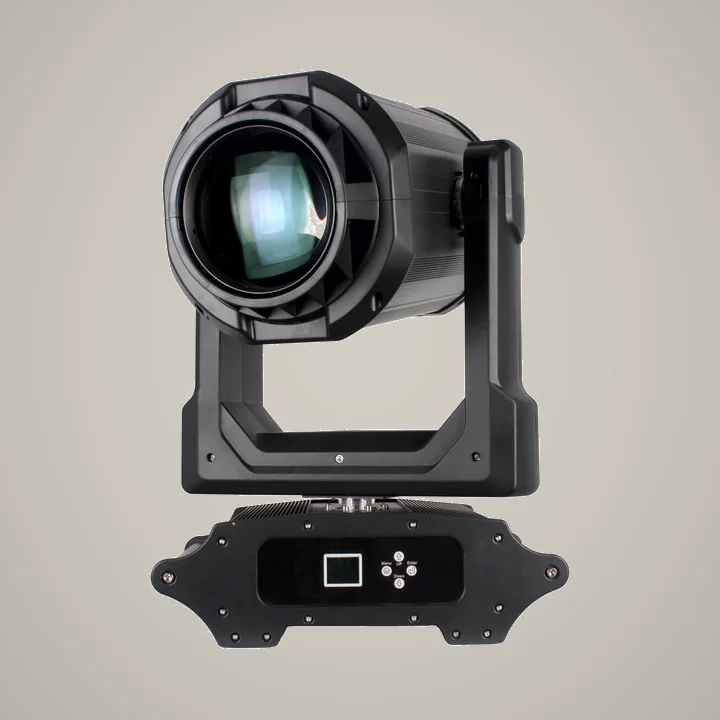
The area input is the projected area of the fixture, meaning the silhouette it presents to the wind, not its shipping footprint. A moving head aimed straight down presents a compact circle. The same fixture tilted toward the audience presents a much larger face plus the length of its yoke and arms. Wash fixtures with wide front lenses behave differently again, because the body and the mounting bracket both catch air.
The shape input is a drag coefficient, which accounts for how smoothly air leaves the object. Vented covers, open framing shutters, cable loops, clamps and protruding hardware all increase turbulence and therefore increase the effective force. Two fixtures of identical weight can load the same truss very differently if one has a smooth housing and the other has deep vent channels and an exposed bracket.
Why a fixture datasheet cannot give a wind rating
Buyers often ask for the maximum wind speed a fixture can withstand. That figure cannot honestly be stated for a product in isolation, because the answer depends on the bracket, the truss, the ballast or ground support, the height above ground and the surrounding terrain. The same fixture at four metres on a sheltered stage and at twelve metres on an open field is two different engineering problems.
A more useful split of responsibility is this: the manufacturer is accountable for the fixture's mass, housing and mounting interface; the rigging designer is accountable for the structural system that carries it; and the event organiser is accountable for the operating decision to keep the rig up or bring it down. Written evidence should exist for each of those three links, and none of them can substitute for the others.
Collect the site and rigging facts first
Wind planning starts as a survey, not a calculation. Before any fixture is quoted, record the facts that the structural work will depend on. Most of them come from the venue, the local authority or the event's temporary-structures engineer rather than from the lighting supplier.
- Design wind speed for the site and season, taken from the applicable local code or the temporary-structures engineer.
- Terrain and exposure: open field, urban shelter, coastal frontage, or a stadium with funnelling between stands.
- Mounting height and the height of the highest fixture above ground or deck.
- Truss type, span, grid layout and the rated capacity of each attachment point.
- Ground support ballast, guy lines, anchors, and the surface they bear on.
- Whether the rig stays up overnight, and who is on site if weather changes.
Exposure matters more than most crews expect. A site described as sheltered can still produce strong local acceleration around containers, screens and stage roofs, and a coastal site adds salt and corrosion to the structural question. Write the assumption down. If the plan says 'sheltered urban site' and the event later moves to an open field, the calculation has to be revisited rather than reused.
Projected area changes with every aiming position
A moving head is not a fixed sail. Its exposed area changes as pan and tilt change, and so does the lever arm acting on the truss. The highest load case is usually not the position the fixture holds during the show, but a position it passes through or is left in during a changeover.
| Aiming position | Exposed face | Planning consequence |
|---|---|---|
| Straight down, beam vertical | Compact top and yoke profile | Lowest area, but the load sits directly over the attachment point |
| Tilted toward the audience | Full front lens plus body length | Largest area and a longer lever arm on the bracket and clamp |
| Horizontal beam across the stage | Long side profile of body and arms | High area with an offset centre of gravity, so the clamp sees torsion |
| Parked in a service position | Depends on the park preset, often forgotten | Must be included in the calculation, not treated as neutral |
The practical rule is to design for the worst aiming position the fixture can reach, including service presets and any position the operator might use during focus. If that is impractical, the rigging plan should state which positions are prohibited above a defined wind speed and how that limit is enforced during the event.
The load path from fixture to ground
Wind force is only a problem where the load path breaks. Trace it deliberately: fixture body, mounting bracket, clamp or coupler, truss chord, truss connection, tower or hoist, ballast or anchor. Every joint in that chain has to be rated for the combined static and dynamic load, and every fastener has to be checked for the vibration that outdoor work produces.
Two details cause a large share of outdoor incidents. The first is an undersized or worn clamp that holds fine when the fixture hangs still and slips when wind adds a torsional load. The second is a secondary safety device attached to the same point as the primary, which provides no independence if that point fails. A separate attachment around the truss, with a rated connector and a short drop, is the standard arrangement.
Ground support adds a further set of checks. Ballast must be calculated for the overturning moment, not simply stacked until the tower feels stable, and guy lines need anchors that are rated for the soil or surface they sit in. On paved surfaces, water-filled ballast and friction both change after rain, which is exactly when wind is also more likely.
Wind resistance and weather protection are separate questions
An IP66 rating describes protection against dust and powerful water jets. It says nothing about structural strength, bracket fatigue or the ability of a clamp to hold under cyclic load. A fully sealed fixture can still be torn from a truss, and a mechanically robust fixture can still fill with water if its cable entries are strained.
Water ingress under wind is its own design problem. Wind-driven rain reaches seams at an angle that a static hose test does not reproduce, and it pushes against cable glands and connector boots. Loop cables so water runs off before it reaches the entry, support them so the gland carries no weight, and inspect boots after every storm rather than only at the start of the season.
The reverse mistake is equally common: treating a sealed housing as permission to leave equipment outdoors indefinitely. Seals age, breathers clog and condensation cycles accumulate. A fixture rated for outdoor use still needs a maintenance interval, and that interval should shorten on coastal sites where salt deposits hold moisture against metal.
Inspection before the event and during it
An inspection that only happens at load-in catches manufacturing faults but misses the conditions that develop during a multi-day event. Build a short routine that can be repeated by the crew on site, and give it a named owner.
- Check every clamp for correct fit, full seating on the chord and tight hardware before the rig goes up.
- Confirm each fixture has an independent secondary attachment.
- Photograph the rig at trim height so later movement can be compared against a reference.
- Re-check ballast, anchors and guy-line tension after the first night and after any rain.
- Walk the rig after each weather event and record findings in a single log.
- Remove any fixture showing cracked covers, loose brackets or damaged cable entries from service.
During the event, someone has to be watching the forecast with authority to act. A gust front arriving at 22:00 with a full audience is not the moment to discover that nobody knows who can call a shutdown. Assign the role in writing at the production meeting and make sure the person is reachable, not merely listed.
Storm response and shutdown criteria
Shutdown criteria should be numeric and agreed before the first fixture is flown. The plan needs two thresholds: a caution level at which the rig is monitored and non-essential fixtures are lowered, and a stop level at which the stage is cleared and equipment comes down. Both values come from the structural calculation and local rules, not from improvisation on the night.
The lowering sequence deserves the same planning as the build. Decide in advance which fixtures come down first, where they are stored, how covers are fitted and in what order power and data are disconnected. Rehearse it once during setup while the crew is calm, because the sequence will be executed under time pressure and poor visibility.
After the weather passes, do not simply power up and continue. Inspect clamps, brackets, safety devices, cable entries and truss connections, and look for fixtures that have shifted on the chord. Water that entered during the storm may not show until the fixture heats up, so a short function test before the next show is worth the time it costs.
What to ask a lighting supplier
A supplier cannot design the rig, but they can give the inputs the designer needs. Ask focused questions and request answers in writing so they can be attached to the rigging plan.
- Net weight and the dimensions of the fixture in its normal and fully tilted positions.
- The mounting interface: bracket geometry, accepted clamp type and recommended hardware.
- Any specified attachment points for a secondary safety device.
- Cable entry design and the recommended strain relief for outdoor use.
- Service access requirements so that maintenance does not require lowering the whole rig.
- Which values are confirmed for the production version and which are still pending.
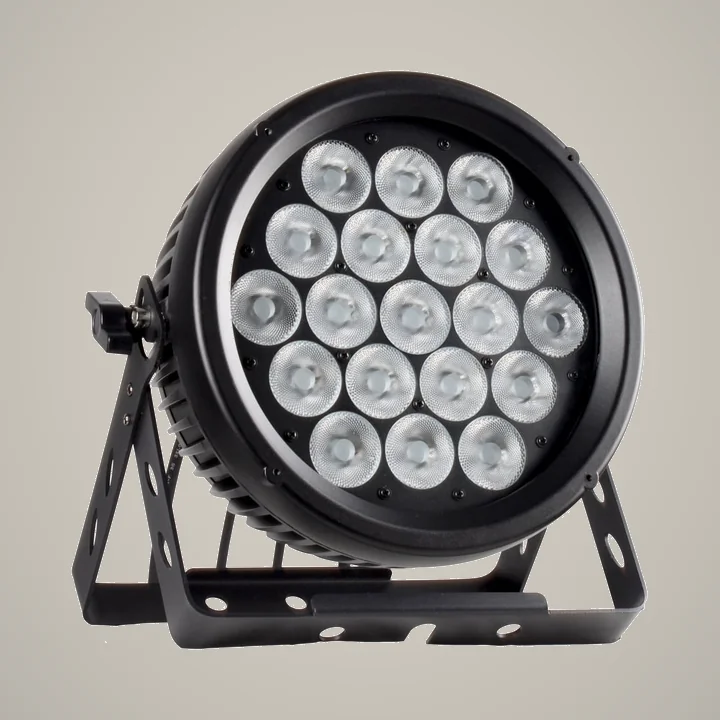
For an IP66 outdoor fixture such as the P1915IP wash light, the useful questions are practical rather than promotional: how the bracket is secured, where water drains, how the seals are serviced, and whether the connectors are included in the protection claim. Those answers feed directly into the structural and maintenance plans.
Documentation and handover
The deliverable of wind planning is a document set, not a feeling of confidence. At minimum it should contain the design wind speed and its source, the exposure assumption, the projected-area figures, the load path with rated capacities, the ballast or anchor calculation, the inspection routine, and the shutdown thresholds with the name of the person authorised to call them.
Hand that set to the crew that will actually build the rig, and keep a copy on site. A plan that lives only on a designer's laptop does not protect anyone at two in the morning when a front is moving in and the crew needs to know which fixtures come down first.
FAQ
Can a manufacturer state a maximum wind speed for an outdoor moving head?
Not meaningfully for the fixture alone. The achievable wind speed depends on the bracket, truss, ballast, height and terrain, so any single figure without rigging context should be treated with caution. Ask for weight, dimensions and mounting geometry instead, and let the rigging designer calculate the system.
Does an IP66 rating mean a fixture is safe in strong wind?
No. IP ratings describe protection against dust and water, not structural strength or clamp retention. A sealed fixture still needs a rated load path, an independent secondary attachment and inspection after weather events.
Which aiming position produces the highest wind load?
Usually a position where the fixture presents its full front face plus body length, because both exposed area and the lever arm on the bracket increase. Service positions and parked presets must be included, since crews often forget them.
How often should an outdoor rig be inspected during a multi-day event?
At least once before the first show, again after the first night, and after every significant weather event. Clamps, safety devices, ballast, guy-line tension and cable entries are the priority checks, and findings should go into one written log.
Who decides when the rig has to come down?
A named person with the authority to stop the show, agreed at the production meeting and recorded in the wind plan. The thresholds themselves should be set by the structural calculation and local requirements before the event begins.